

Porting a Business Phone Number to VoIP: What Canadian SMBs Need to Know
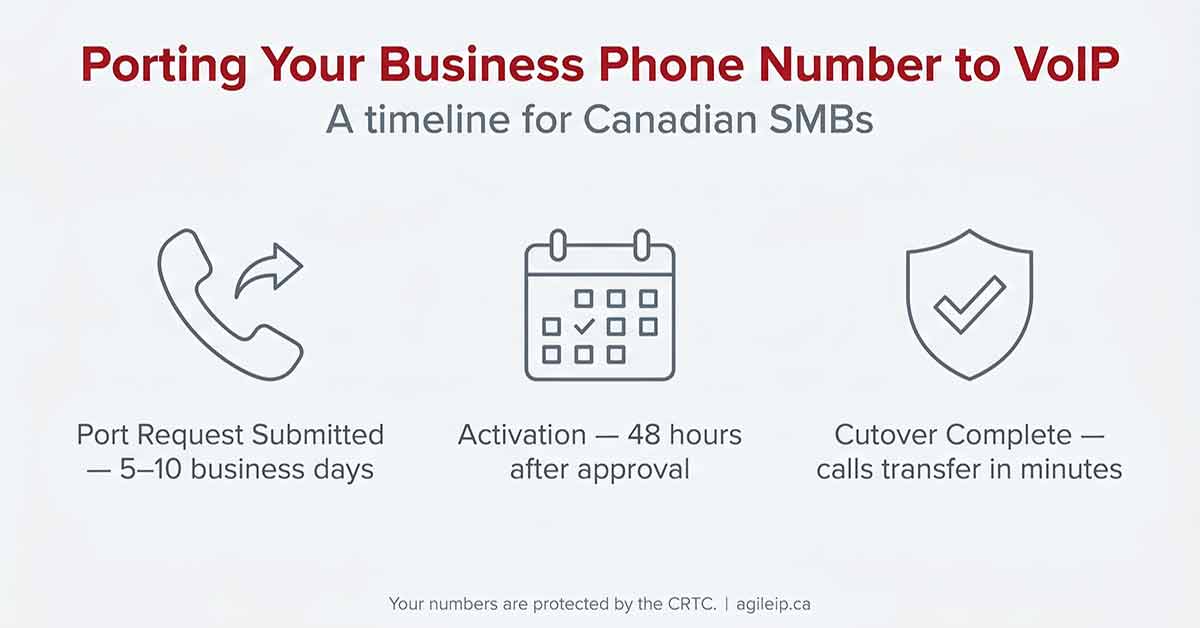
“Will I lose my phone number?” is usually the first practical question a business owner asks when evaluating a switch to VoIP. The short answer is no. Your numbers belong to you, and CRTC rules protect that. The longer answer is that the process, called number porting or Local Number Portability, has a few moving parts worth understanding before you start. What follows is what a Canadian SMB should know about porting a business phone number to VoIP in Canada: how it works, how long it takes, what can go wrong, and how to keep the cutover uneventful.
How does porting a business phone number to VoIP work?
Number porting is the administrative process of moving your phone number from one carrier to another without changing the number itself. It is governed in Canada by the CRTC’s Local Number Portability framework, which requires every carrier to release numbers when the customer requests it. Your new provider submits the port request on your behalf and coordinates with the losing carrier to schedule the transfer. You keep the number. Your customers, suppliers, and printed business cards all keep working.
Porting covers local numbers, toll-free numbers, and most direct dial numbers (DIDs) attached to your phone system. It does not transfer bundled services like internet or television, nor voicemail messages stored at your current carrier.
How long does porting take in Canada?
Once a complete and accurate port request is submitted, the carrier step typically takes 5 to 10 business days. Activation on your new phone system follows within roughly 48 hours of receiving porting approval from the losing carrier. This timeline is set by carrier processes, not your new provider’s scheduling, which is why firm go-live dates are realistic only after the port request is accepted.
A few factors affect actual duration. Toll-free numbers usually port faster than local numbers. Large ranges of 10 or more DIDs can take longer because each number is validated individually. And any mismatch between your old carrier’s account records and the port request restarts the clock. Plan your timeline from the date the port request is submitted, not from the day you sign with a new provider.
What can go wrong during a port?
The most common problem is a port rejection. Carriers reject port requests when the details on the request do not exactly match the details on the account at the losing carrier: the business legal name, the service address, the billing telephone number, or the authorized contact. Rejections are fixable, but each round adds days.
The second most common issue is a port freeze. Some carriers place a security hold on accounts that blocks outgoing port requests until the account holder explicitly lifts it. The freeze is an anti-slamming measure, not a penalty, but you or your new provider will need to call the losing carrier to remove it before the port can proceed.
The third issue is cancelling service too early. If you cancel before the port completes, the number is released back into the general pool and may not be recoverable. Never cancel the old service until the port is confirmed complete on the new one.
How do you prevent service interruption?
The single most important factor is the order of operations. Porting is designed so calls are not dropped: your old line stays active until the port cuts over, and calls begin ringing on the new system within minutes of the transfer. Interruptions happen when the customer deviates from that flow, usually by cancelling the old account, moving the physical line, or changing the billing address mid-port.
A few practical preparations reduce risk. Pull the latest bill from your current carrier before starting, because most rejections trace back to outdated account details. Confirm who the authorized contact is on the losing carrier’s records, since the port letter must be signed by that person. Schedule the cutover during business hours mid-week so both your new provider and the losing carrier are reachable if anything needs adjustment. And keep your old hardware connected until the cutover is confirmed – replacing phones too early leaves a window where neither system is fully live. Porting a business phone number to VoIP is designed to be seamless when these steps are followed in order.
What does AgileIP handle, and what do you handle?
Porting practices vary across the Canadian VoIP market. Most providers treat porting as a billable item – a per-number fee, a setup charge, or a line item restricted to higher-tier plans. Some providers, like AgileIP, include number porting on every line at no additional cost, with submission, carrier coordination, and cutover handled by the provider as part of standard managed deployment.
Your responsibility is to provide accurate account details from the losing carrier and sign the port authorization. AgileIP submits the port request, coordinates with the losing carrier, resolves rejections if they occur, and schedules the cutover so your new phones are configured and tested before the number transfers.
Contract structure rounds out the picture. Traditional phone lines in Canada are typically sold under multi-year contracts with early termination fees. Most VoIP providers in Canada also require annual or multi-year commitments. Some providers, like AgileIP, operate month-to-month with no termination fees – which, combined with included porting, means there is no entry fee to start and no exit fee to leave. Switching providers becomes an operational decision, not a contract decision.
If you are planning on porting a business phone number to VoIP in Canada and want to walk through what your specific port would look like, contact AgileIP for a free consultation – no obligation, no pressure.
Frequently asked questions
Local numbers, toll-free numbers, and DIDs are eligible under the CRTC Local Number Portability framework. Your new provider can confirm which of your existing numbers are eligible before you commit. For a broader view of what to evaluate when switching, see How to Choose a VoIP Provider in Canada.
Yes, until the port cuts over. Cancelling early releases the number back into the general pool and it may not be recoverable. The right to cancel and port is unconditional under CRTC rules – but timing matters. Cancel after the port completes, not before.
Not if the cutover is sequenced correctly. Your old line stays active until the port cuts over, new phones are configured and tested in advance, and calls route to the new system within minutes of the transfer. Interruptions typically trace back to cancelling the old service early or moving the physical line during the porting window.
Most Canadian VoIP providers either charge a per-number porting fee or restrict porting to higher-tier plans. Some, like AgileIP, include porting on every line at no additional cost. Confirm pricing and tier restrictions before you sign. For a broader view of what a Canadian business should weigh when switching, see the VoIP buyer’s guide for Canada.
YOU MIGHT BE INTERESTED IN:
We offer free consultations to assess your needs and help you make an educated choice.