

VoIP vs. Traditional Phone System: What Changes When Your Business Makes the Switch
Most Canadian businesses still running a traditional phone system are weighing the same question: is it time to switch to VoIP? The short answer depends on what you need from your phone system and what you are willing to manage yourself. This article compares the two models directly – what you gain, what changes, and what stays the same.
How a traditional business phone system works
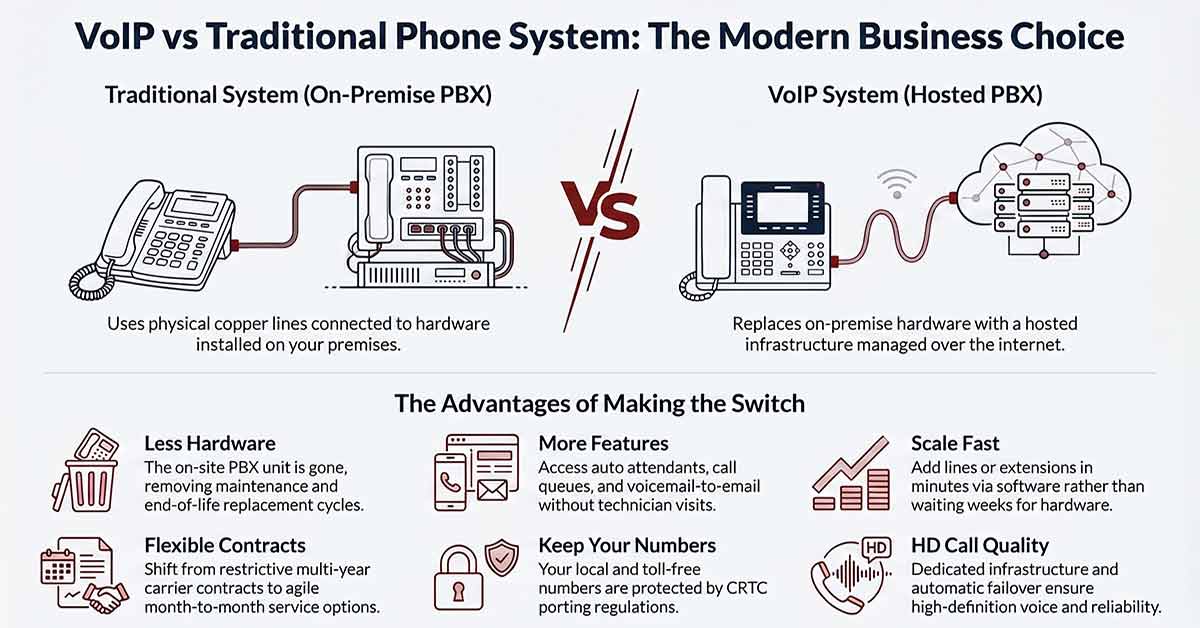
A traditional phone system connects your office to the public phone network through physical copper lines. Each line supports one concurrent external call. The hardware that manages those lines – routing calls to desks, handling holds and transfers – is a PBX unit installed on your premises. You own it, maintain it, and replace it when it fails or reaches end of life.
The carrier (Bell, Telus, Rogers, Videotron) owns the lines. You pay per line under a service contract, typically multi-year. Adding lines means ordering new physical connections from the carrier. Removing lines means waiting for the contract to expire or paying early termination fees.
How VoIP replaces traditional phone system infrastructure
A VoIP phone system – often called a hosted PBX – routes calls over the internet instead of copper lines. The provider owns and operates the infrastructure remotely. The PBX hardware that used to sit in your office is replaced by the provider’s equipment in their facility. Your phones connect to it over your existing internet connection.
The practical result: you get a full business phone system without owning or maintaining the central hardware. The provider handles configuration, updates, redundancy, and failover. Your IT team manages the local network – router, QoS settings, switch – but not the phone system itself. For a detailed look at how VoIP evolved from traditional phone lines to on-premise systems to hosted infrastructure, see Understanding VoIP Phone Systems.
What changes when you switch from traditional to VoIP
The hardware in your office shrinks. The on-premise PBX unit is gone. IP phones remain on desks, but the system that manages them lives in the provider’s infrastructure. There is no hardware to maintain, no end-of-life replacement cycle, and no service calls when the unit fails.
The feature set expands significantly. A traditional PBX handles basic call routing. A hosted VoIP phone system includes auto attendant with scheduled routing, call queues, ring groups, voicemail with email delivery, call monitoring, and three-way calling – managed by the provider, not a technician visit. Call recording and softphone access for mobile and desktop are available as add-ons.
Scaling becomes a configuration change. Adding lines or extensions on a traditional system means hardware capacity limits and carrier lead times. On a VoIP system, lines are added in software. A new hire or a seasonal spike in call volume is handled in minutes, not weeks.
Contract structure can change. Traditional phone lines are typically sold under multi-year contracts with early termination fees and annual price escalation clauses. Most VoIP providers in Canada also require annual or multi-year contracts. Some, like AgileIP, operate month-to-month with no termination fees — shifting the retention model from contractual obligation to ongoing service quality.
Cost structure shifts from per-line carrier fees to provider pricing. Traditional lines carry a per-line monthly fee set by the carrier. VoIP providers price either per user or per concurrent line, depending on the provider. The model you choose affects total cost significantly as headcount grows. For a detailed comparison of how these pricing models work, see VoIP Phone System Cost in Canada.
What stays the same
Your phone numbers. Number porting transfers your existing local and toll-free numbers to the new VoIP system. CRTC regulations protect your right to port regardless of contract status. Porting timelines depend on carrier approval and typically take 5 to 10 business days at the carrier level.
How your team uses the phone. Desk phones still ring. Calls are still transferred, held, and conferenced. The daily workflow for staff does not change – the system behind it does.
Call quality expectations. A properly configured VoIP phone system on dedicated infrastructure delivers HD call quality. The key factors are network configuration (QoS enabled on your router) and the provider’s infrastructure quality – not internet speed. Ten concurrent calls use roughly 1 Mbps of bandwidth.
Why Canadian businesses are switching to VoIP
The shift from traditional phone systems to VoIP is not a future trend – it is already well underway. The global VoIP market is growing at roughly 11% per year and is expected to more than double in size by the early 2030s. North America accounts for over a third of that market. The drivers are consistent across industries: lower operating costs, better feature sets, and the ability to support remote and hybrid work without additional infrastructure.
In Canada specifically, the underlying infrastructure that traditional phone systems depend on is being retired. Canadian carriers are actively decommissioning legacy copper networks. Bell has a formal copper decommissioning program in progress, and CRTC filings from 2025 and 2026 document the withdrawal of multiple legacy services built on aging copper and TDM infrastructure – services for which manufacturer support ended years ago and replacement parts are no longer available. The CRTC itself describes this as a transition from “a public switched telephone network to an Internet-Protocol-centric environment.”
This does not mean traditional lines will disappear overnight. Carriers continue to offer business phone lines, and the transition is happening at different speeds in different regions. But the direction is clear: the infrastructure that traditional phone systems rely on is being phased out, and the systems replacing it are IP-based. For businesses still operating on traditional lines, the question is less whether to switch and more when – and on what terms.
If you are evaluating VoIP providers, the questions that matter most are about infrastructure ownership, pricing model, contract terms, and what is included in the base service. For a complete provider evaluation checklist, see Business VoIP Phone Systems in Canada: A Buyer’s Guide.
Frequently asked questions
Yes. Call quality on a VoIP phone system depends on the provider’s infrastructure and your network configuration. Dedicated physical infrastructure gives the provider direct control over codec selection, quality-of-service priority, and failover. A stable business internet connection with QoS enabled on the router completes the picture.
Not necessarily. Many IP phones are compatible with hosted PBX systems. Your provider should confirm compatibility with your existing equipment before deployment. New phones are available if needed, and typically ship preconfigured.
The transition timeline depends on the scope of the deployment and number porting. Porting timelines are set by carrier approval and typically take 5 to 10 business days at the carrier level. Most businesses are fully operational on the new system within days of activation. For a step-by-step view of what the process involves, see Multi-Line Business Phone Systems.
Yes. Some businesses run a hybrid setup during transition. However, maintaining two systems adds complexity and cost. Most businesses that start the switch complete it once they see the feature and cost difference.
YOU MIGHT BE INTERESTED IN:
We offer free consultations to assess your needs and help you make an educated choice.