

Replace NEC Phone System in Canada: SV9100, SL2100, and UNIVERGE Systems
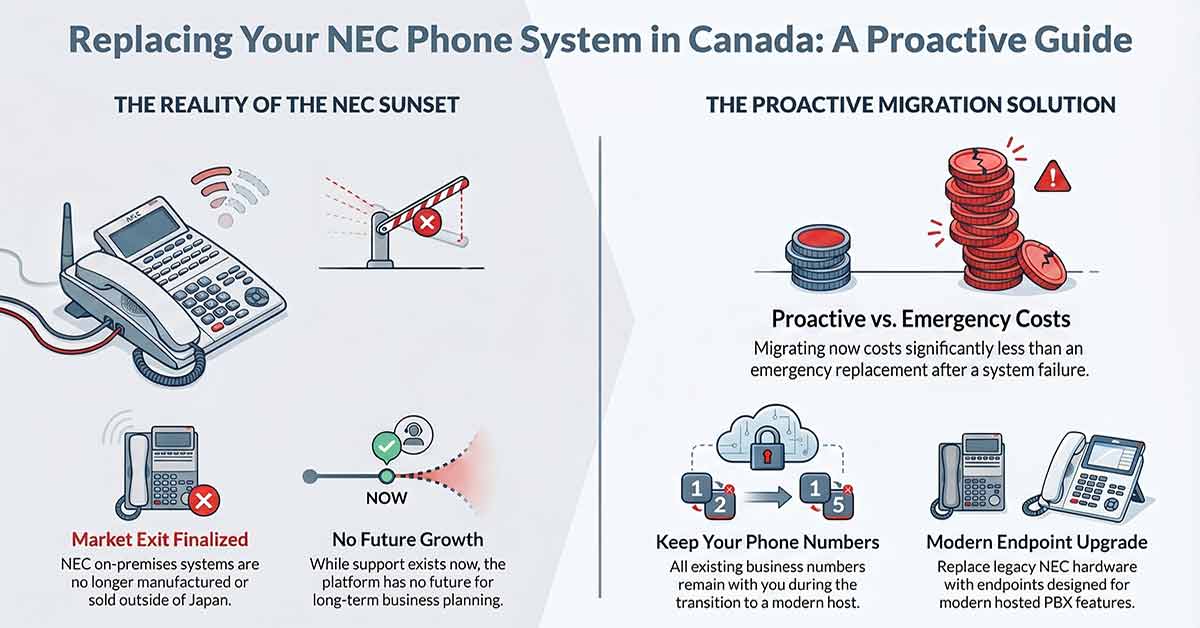
If you need to replace NEC phone system hardware in Canada, whether an SV9100, SL2100, SL1100, SV9500, or UNIVERGE 3C, this article is for you.
NEC exited the on-premises business phone market outside Japan, so these specific on-premises systems are no longer made or sold. Support has not vanished overnight, but the platform has no future, and that is the part that matters for planning.
What the lifecycle record actually says
NEC exited the on-premises business phone market outside Japan. It announced the decision in 2024 and ended new system sales at the end of that year. Support did not stop at the same time: a third party, Forerunner Technologies, acquired NEC’s on-premises business in the Americas in early 2025 and provides software support and licensing through 2030, and NEC extended its own support window to the same date. What has stopped is the platform itself. No new hardware is manufactured, the SL2100 production line is permanently closed, and there is no future roadmap.
| Event | Date |
|---|---|
| NEC announces exit from on-premises UC outside Japan | 2024 |
| End of New System Sales and Add-On Sales (SV9100, SV9500, UNIVERGE 3C, SL2100) | December 31, 2024 |
| End of Shipment | March 31, 2025 |
| Forerunner Technologies acquires NEC’s on-premises UC business in the Americas | February 2025 |
| End of Support, remaining platforms (standard) | March 31, 2026 |
| End of Support, SV9300 | March 31, 2027 |
| End of Support, remaining platforms (extended via SWA contract) | March 31, 2030 |
The systems affected include the SL2100 and SL1100 for small business, the SV9100 and SV9500 for mid-market and larger deployments, the SV9300, and UNIVERGE 3C, along with the NEC DT-series desk phones built for them.
What “no manufacturer support” means in practice
Even with support available for a few more years, a discontinued platform changes the picture in ways worth understanding.
- No new hardware from NEC. New systems, expansion cards, and phones cannot be ordered from NEC as of the end of 2024, and the SL2100 production line is permanently closed. Replacement hardware now comes from existing reseller inventory or the refurbished secondary market, which depletes over time.
- A fixed support runway, not an open-ended one. Support for most platforms runs to March 31, 2030, with the SV9300 ending earlier in 2027, and it typically requires active software assurance. After those dates, there is no manufacturer or successor support to fall back on.
- No future development. With the platform discontinued, there is no ongoing roadmap. New features are not coming, and software updates depend on the remaining support contracts rather than continued product development.
- A narrowing technician base. As the channel that serviced NEC systems for decades reorganizes, the pool of technicians trained on these platforms shrinks every year.
The operational question is not whether the system works today. It is whether you choose your migration timeline, or a hardware failure or the support cutoff chooses it for you.
Migration considerations
The path from an NEC system to a modern phone system is well established. A few specifics are worth knowing before you start:
- Your phone numbers stay with you. Under CRTC regulations, your business phone numbers belong to your business, not to your current provider. Porting to a new provider does not require carrier permission and is independent of any contract status. Porting timelines depend on carrier approval and typically run 5 to 10 business days at the carrier level.
- Most NEC endpoints are not built for a modern hosted PBX. NEC’s DT-series digital and IP desk phones, the DT300, DT400, DT500, DT700, DT800, and DT900 families, were built for NEC’s own platforms and do not carry to a modern IP-based hosted PBX. Migration planning should assume new IP desk phones, softphones, or a mix of both.
- Proactive migration costs less than emergency replacement. Planning a migration on your own timeline allows for staff training, parallel running, and a clean cutover. Replacing a system after it fails compresses all of that into days rather than weeks.
What changes when you replace NEC phone system hardware
The architectural shift is the point. An SV9100 or SL2100 is hardware in your equipment room. A modern hosted PBX moves the system into the provider’s infrastructure, leaving only desk phones and softphones at your sites. Adding lines, adding extensions, adding a second location, and adjusting call routing become configuration changes in software rather than hardware orders.
Infrastructure ownership across Canadian providers varies in ways worth asking about. Some providers operate their own dedicated physical infrastructure with direct carrier connectivity. Others resell capacity from another provider on shared infrastructure, adding a layer between you and the call path. Others run on shared virtualized platforms where capacity is allocated dynamically across tenants. The categories are not mutually exclusive, and they affect call quality and reliability differently.
Contract structure varies similarly. Traditional phone lines were typically sold under multi-year contracts with early termination fees and annual price escalation clauses. Most VoIP providers in Canada also require annual or multi-year contracts. Some, like AgileIP, operate month-to-month with no termination fees, shifting the retention model from contractual obligation to ongoing service quality.
How AgileIP fits
Some providers, like AgileIP, operate their own dedicated physical infrastructure, with installation, system configuration, number porting, and staff training included on every line. For a business that needs to replace NEC phone system equipment, the managed deployment model removes the operational burden that often kept the legacy system in place. Pricing is per concurrent line rather than per user, which typically produces lower total cost as a business grows.
If you’re running an NEC SV9100, SL2100, or UNIVERGE system and want to understand what a migration looks like for your specific configuration, contact AgileIP for a free consultation, no obligation, no pressure.
Frequently asked questions
For now, in most cases. NEC exited the on-premises market and ended new system sales at the end of 2024, but support for most platforms runs to March 31, 2030 (the SV9300 ends earlier, in 2027), typically with active software assurance, and a third party, Forerunner Technologies, took over the Americas on-premises business in 2025. What has ended is new hardware and future development, so the system is supported for now but has no roadmap beyond the cutoff.
No. NEC Corporation continues to operate and still sells cloud communications. What changed is that NEC exited the on-premises business phone market outside Japan, so these specific systems are discontinued. The reason to consider a migration is the discontinued platform, not the status of the company.
Yes. Under CRTC regulations, your business phone numbers belong to your business and can be ported to any provider regardless of your current contract status. Porting timelines depend on carrier approval and typically run 5 to 10 business days at the carrier level.
In most cases, yes. NEC’s DT-series desk phones were built for NEC’s own platforms and do not work on a modern IP-based hosted PBX. Migration planning should assume new IP desk phones, softphones, or a mix of both.
Support is not the same as a future. No new hardware is being made, the SL2100 production line is permanently closed, and replacement parts come only from depleting inventory and the refurbished market. A system that needs to expand, or that loses a component, can be difficult to keep running well, and the 2030 cutoff (2027 for the SV9300) is a fixed deadline. Planning a migration on your own timeline avoids both the deadline and an emergency replacement after a failure.
A planned migration from an SV9100 or SL2100 to a modern hosted PBX typically runs a few weeks from decision to cutover, depending on number porting timelines and the complexity of your existing call routing. Emergency replacements after a hardware failure compress the same work into days and remove the option of parallel running.
YOU MIGHT BE INTERESTED IN:
We offer free consultations to assess your needs and help you make an educated choice.