

How to Stop Missing Business Calls: Six Causes and Their Fixes
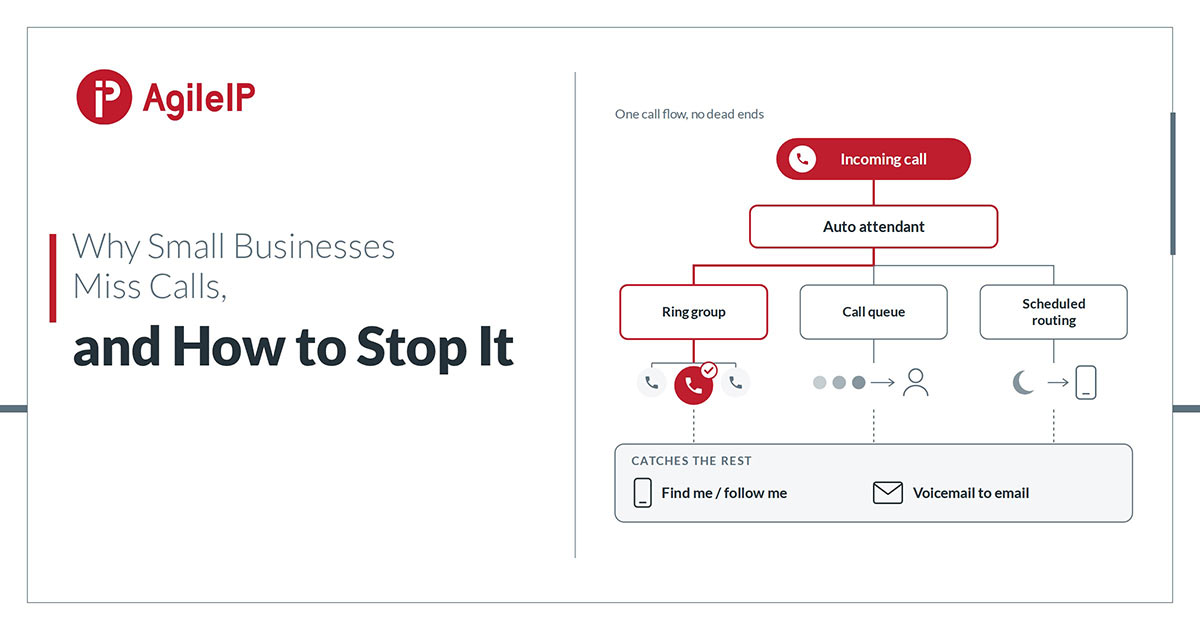
To stop missing business calls, a small business rarely needs more staff. Most missed calls are not caused by a shortage of people; they are caused by a phone setup that sends every call to one place and hopes someone is there. The caller hears ringing, then voicemail, and many of them hang up and dial the next name on their list. Those are the missed calls small business owners never hear about. This guide walks through the six most common reasons business calls go unanswered and the phone system feature that fixes each one. None of the fixes require hiring anyone.
1. Every call rings one phone
The main number rings the front desk, or the owner’s phone, and nowhere else. When that one person is on another call, at lunch, or helping a customer in person, the call goes unanswered even though three other people in the building could have taken it.
The fix is a ring group. A ring group sends an incoming call to several phones at once, or to one after another in a set order, so the first available person picks up. The front desk still answers most calls; the group is the safety net for the moments it cannot.
2. Callers cannot reach the right person
A caller wants to book an appointment, or ask about an invoice, or reach a specific person. Whoever answers has to figure out where the call belongs, put the caller on hold, and hunt. Calls get dropped in the shuffle, or the caller gives up while waiting.
The fix is an auto attendant. An auto attendant (sometimes called an IVR) is a recorded greeting with a short menu: press 1 for appointments, 2 for billing, 0 to reach the front desk. The caller is routed to the right ring group or person on the first try. A well-designed menu is short, offers a way to reach a human on every branch, and answers the most common question, opening hours, before the caller has to ask.
3. Nobody answers at lunch, evenings, or weekends
Business hours are not the only hours customers call. A restaurant gets reservation calls at 5 p.m. on a Sunday; a plumber gets emergency calls at midnight. If the phone just rings out, the caller assumes the business is closed for good, or calls a competitor who picks up.
The fix is scheduled routing. The auto attendant can play a different greeting outside business hours, with the hours themselves and the option to leave a message or reach an on-call person. Scheduled call forwarding sends after-hours calls to whoever is on duty that week. The schedule runs itself; nobody has to remember to switch the phones over at closing.
4. Callers hang up while on hold
Being put on hold in silence feels like being forgotten. Callers hang up after a surprisingly short time, and a hung-up call is a missed call even though someone technically answered it.
The fix is a call queue. A call queue holds callers in order, plays music or a recorded message so they know they are still connected, and hands each one to the next available person. For busy periods, queue callback is available as an add-on: the caller hangs up and the system calls them back when their turn comes, instead of making them wait on the line.
5. Voicemail messages sit unheard
The caller does leave a message. Then it sits in a voicemail box that someone checks at the end of the day, or the next morning, and by the time the business calls back, the customer has already booked elsewhere.
The fix is voicemail delivered by email. Each message arrives in the inbox as an audio file, with the caller’s number, the moment it is left. Anyone on the team can hear it from a desk, a laptop, or a cell phone, and the return call happens within minutes rather than hours. Voicemail with email delivery is one of the included phone system features on a hosted VoIP system.
6. The person the caller needs is out of the office
Sales staff are at appointments. The owner is on a job site. The bookkeeper works from home on Fridays. The call rings a desk that nobody is sitting at.
The fix is to bring the line to the person. Find me / follow me rings the desk phone first and then the person’s cell phone, so the call finds them wherever they are that day, and falls to the business voicemail if it finds nobody. For staff who work from their cell phones most of the day, a softphone app is available as an add-on: it puts the business line itself on their phone, so incoming calls ring the app and outgoing calls show the business number, across Canada. The full picture is in the guide to ringing a business phone number on a cell phone. A business with no phone system at all has a simpler route: Single Number Reach, offered as a standalone service, is one business number that rings several phones at once and sends unanswered calls to a single voicemail box; see the Single Number Reach page.
Putting it together: how to stop missing business calls
The six fixes form one call flow, and that flow is what it takes to stop missing business calls without adding staff. The auto attendant greets and routes; ring groups and queues make sure someone answers; scheduled routing covers the hours nobody is at a desk; find me / follow me and voicemail to email catch whatever gets through. Most of this is included with every line on a hosted VoIP phone system: auto attendant with scheduled routing, ring groups, call queues, call forwarding, find me / follow me, and voicemail with email delivery. The softphone, queue callback, and call logs, which show which calls were missed and when, are available as add-ons.
The other question is who sets it up. On many self-service phone platforms, the business owner is expected to build the call flow in a web portal and maintain it. Some providers, like AgileIP, design the routing with the customer, configure it as part of the installation, and adjust it on request afterward, so a change in hours or a new hire is an email, not a project. Service is month-to-month, with no multi-year lock-in and no penalty for leaving; AgileIP keeps a customer’s business by earning it, with call quality and service, every month. A quote request is the practical first step to stop missing business calls: it puts a line count and a call flow to the business, with no obligation attached.
Frequently asked questions
No. An auto attendant handles the greeting and routing, ring groups make sure several people can answer, and voicemail delivered by email catches the rest. Many small businesses stop missing business calls with that combination alone. A receptionist is still valuable for the personal touch, but the phone system should not fall apart when that person steps away.
Long menus do. A good auto attendant has three or four options at most, states the opening hours up front, and lets the caller press 0 for a person on every branch. Callers who reach the right department on the first try are happier than callers who reach the wrong person quickly.
Every branch of the menu should include an option to reach the front desk or a ring group, and the attendant can be set to send callers who press nothing to a person after a few seconds. The menu is a shortcut for callers who know what they want, not a wall in front of the ones who do not.
Voicemail delivered by email shows every caller who left a message. For a complete record of inbound, outbound, and missed calls per line, call logs are available as an add-on.
YOU MIGHT BE INTERESTED IN:
We offer free consultations to assess your needs and help you make an educated choice.